When it comes to learning a new language, there comes a point where you can feel stuck, especially if you having been learning the language for a while, or in my case, several years. You’re not exactly a ‘beginner’ so resources like textbooks feel boring and uninspiring but native level resources can still be daunting to approach. However, it’s important to continue to push through so you can get to that level where you can use native-level resources with ease, or so I’ve been telling myself as well. I’ve taken a break due to other things but have recently gotten back to my Somali studies. In this post, I share my ways of engaging with Somali to improve and keep me on the path of proficiency.
Reading
I’ve personally found some aspects of Somali to be challenging to get my head around and one way I’ve been trying to make grammar to feel natural and intuitive to me is by reading. A few years ago, there were very few books in Somali and even fewer targeted to anyone other than young children. Depressing. However, at the start of the year, I thought that there surely finally be books suited for learners in 2026? A quick google search did not disappoint! I decided to buy one book for now, 20 Somali Short Stories for Beginners on my e-reader.
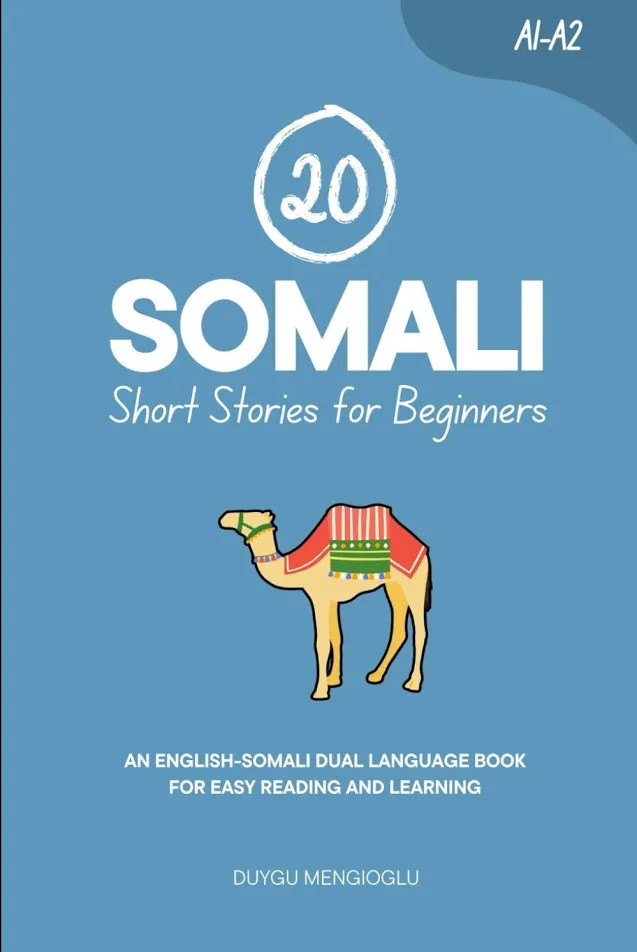
20 Somali Short Stories for Beginners: An English-Somali Dual-Language Book for Easy Reading and Learning (Learn Somali) https://amzn.eu/d/0evylRi5
It’s a collection of short stories. Each story is in Somali, followed by a word list of new vocab, a few questions in Somali and then the English translation.
I personally have found the stories interesting to read and it’s been a nice way to re-engage with Somali, especially after a long break during Ramadan. Even though I would consider myself a bit more advanced than ‘A2’, I’ve still been learning a lot from this book. I’ve learnt plenty of new words and even for words that I’ve knew before, I’ve seen it used in a new way. I’m hoping that through reading the short stories the grammar will become internalised as well.
I’ve seen other books as well, which after I’ve finished this book I will also get. Most likely this book in this series:
Intermediate Level Somali Storybook (B1 & B2): Learn Somali with 25 Fairytale Stories (Learning Somali with Ease) https://amzn.eu/d/0hHyvq2y
This book might be too challenging if you are just starting to learn Somali, as in pre-A1/A0 stage. It does require working knowledge of grammar and if you don’t, it might be too complex and a frustrating read. If that’s you, and you are just starting to learn Somali, reading stories for very young children can still be helpful in terms of exposure to basic vocab and grammar without actively studying it. I recommend this great initiative, by Storybooks Canada, which has different stories for young children translated into Somali and many other languages as well.
https://www.storybookscanada.ca/stories/so/
Watching shows
Another aspect of language learning that can be challenging is understanding and listening to real-time speech. Listening is a skill that I find needs to be honed over time and again, there isn’t a lot of resources out there suitable for learners like me. Children’s content and baby shows are unstimulating yet content like news and topic based youtube channels can be hard and require a vast range of vocab. If you have no prior exposure to Somali (as in, no one spoke it at home, you can’t really understand Somali) in order to watch shows you do need to have some vocab, so I don’t think this step is beginner friendly. I would recommend studying some of the textbooks (Colloquial Somali) and having a working knowledge of Somali otherwise this step might be frustrating. Watching shows in Somali can help once you’ve passed the beginning stage of learning Somali to help you get a rhythm for the speech, pick up new vocab and see the difference between ‘textbook’, standardized Somali and the Somali spoken every day. This is hard though because a lot of shows do not have English subtitles and on Youtube, there is no Somali subtitles as well. I would recommend building yourself up though, by watching at a slower speed, watching a few minutes at a time and trying to see what you have picked up and then carrying on watching some more, pausing again, testing yourself. This is a long process so I would only watch a few minutes at a time and then re-watch a few times. This is still quite challenging but I have been enjoying watching Somali shows. The acting is really good and the production is getting better with each show. If you can’t manage whole episodes, you can watch Youtube Shorts of scenes from shows on repeat as many times as you want and then see how much you understand.
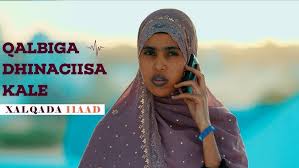
Arday is a show with English subtitles. There is also Somali React, a youtube channel that has many different scenarios and after that you can challenge yourselves with shows like Qalbiga Dhinaciisa Kale, which don’t have English or Somali translation! Even if I don’t understand everything, being able to follow through the story is an achievement itself at this stage, and hopefully you all will get there too.
I hope you find these tips helpful. If you want to know where to actually start, check out my earlier post. https://iftiinlearns.com/2026/01/09/how-to-start-learning-somali-in-2026/
Mahadsanid for reading and nabad gelyo!

Without knowledge there is no light
 Iftiin Learns
Leave a comment